#15: Winter Sowing, Part 3
The good news: I think I managed to grow 200 native plants from seed. The bad news: they might die before I actually get them all separated.
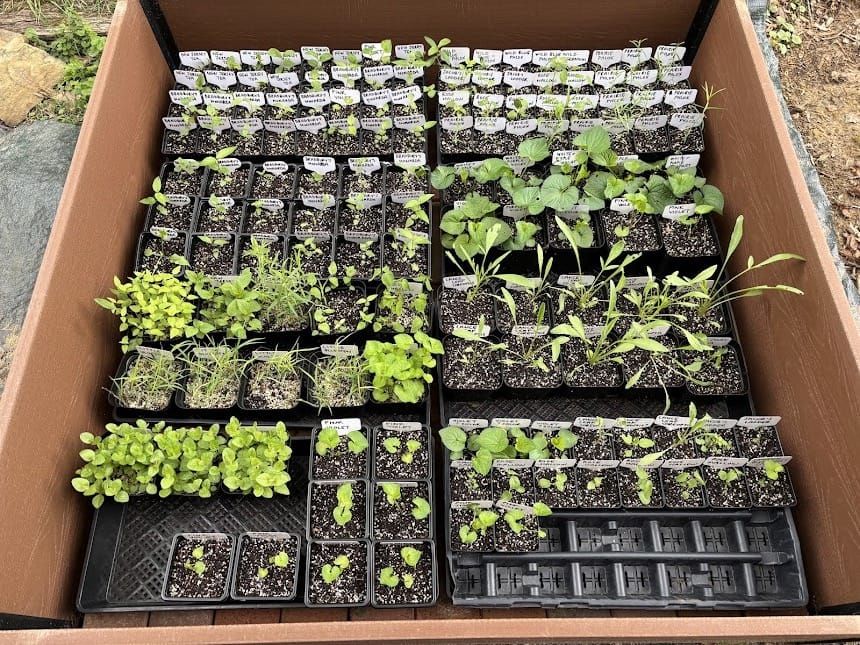
My first attempt at winter sowing went from excitement at the first signs of success to overwhelm when it became clear just how successful the experiment was.
Since the directions I followed said to sprinkle a lot of seeds in the same container, I now have to separate all of the plants I grew into their own containers so they don't compete with each other or get too root-tangled to separate.
Some have been easier than others. I only managed to germinate a single Wild Geranium (Geranium Maculatum) seed, and only three total Wild Blue Phlox (Phlox Divaricata) seeds germinated.
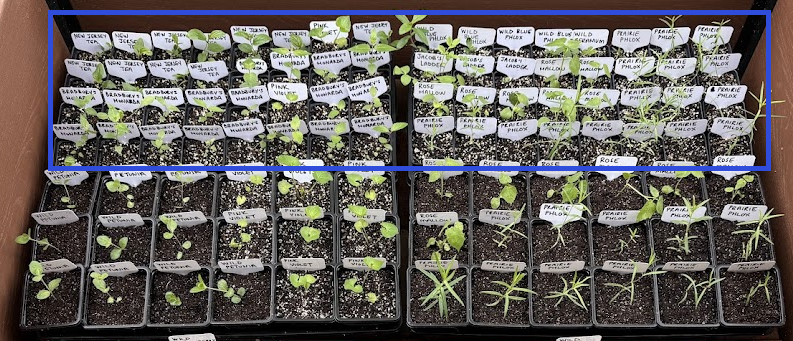
On the other hand, many of my seeds germinated prolifically. I think I probably have 30 New Jersey Tea (Ceanothus Americanus), 40 Wild Petunia (Ruellia Humilis), and close to 60 Bradbury's Monarda (Monarda Bradburiana).
Since I'm still not finished, I don't know exactly, but I'm guessing I ended up with close to 200 plants from my $45 investment in seeds.
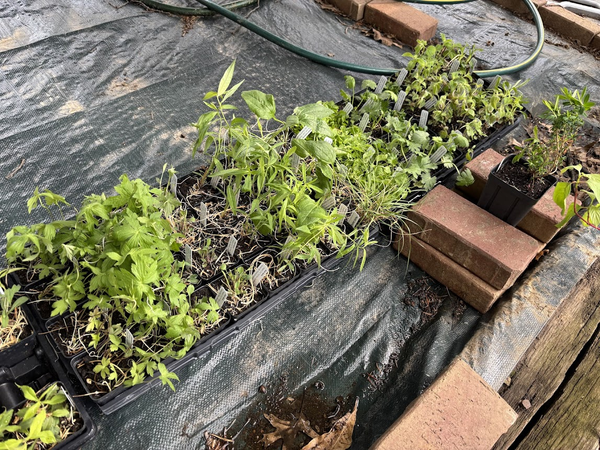
I have so many plants that I actually ran out of room in my sowing box and had to take over my back deck as well. It's a fairly shady place that's one story off the ground and has a lockable gate, so I can keep deer and rabbits away from the young plants (though the occasional squirrel still stops by to dig up a plant in search of a buried acorn 😩).
I have no idea what I'm going to do with all of these plants, but the good news is that most of them had only one long root when I separated them, so they still have plenty of growing to do before they can go in the ground. I have time to come up with a plan.
Separating the plants into their own containers
It's not particularly difficult to separate the plants from each other; you just have to be gentle with them, massaging the dirt to get the roots loose.
Most of my plants just have one long root each, and they typically weren't tangled in a way that made them impossible to get apart. There were times where I had to be rougher and some roots broke, but I haven't lost any plants because of it. They seem pretty resilient.
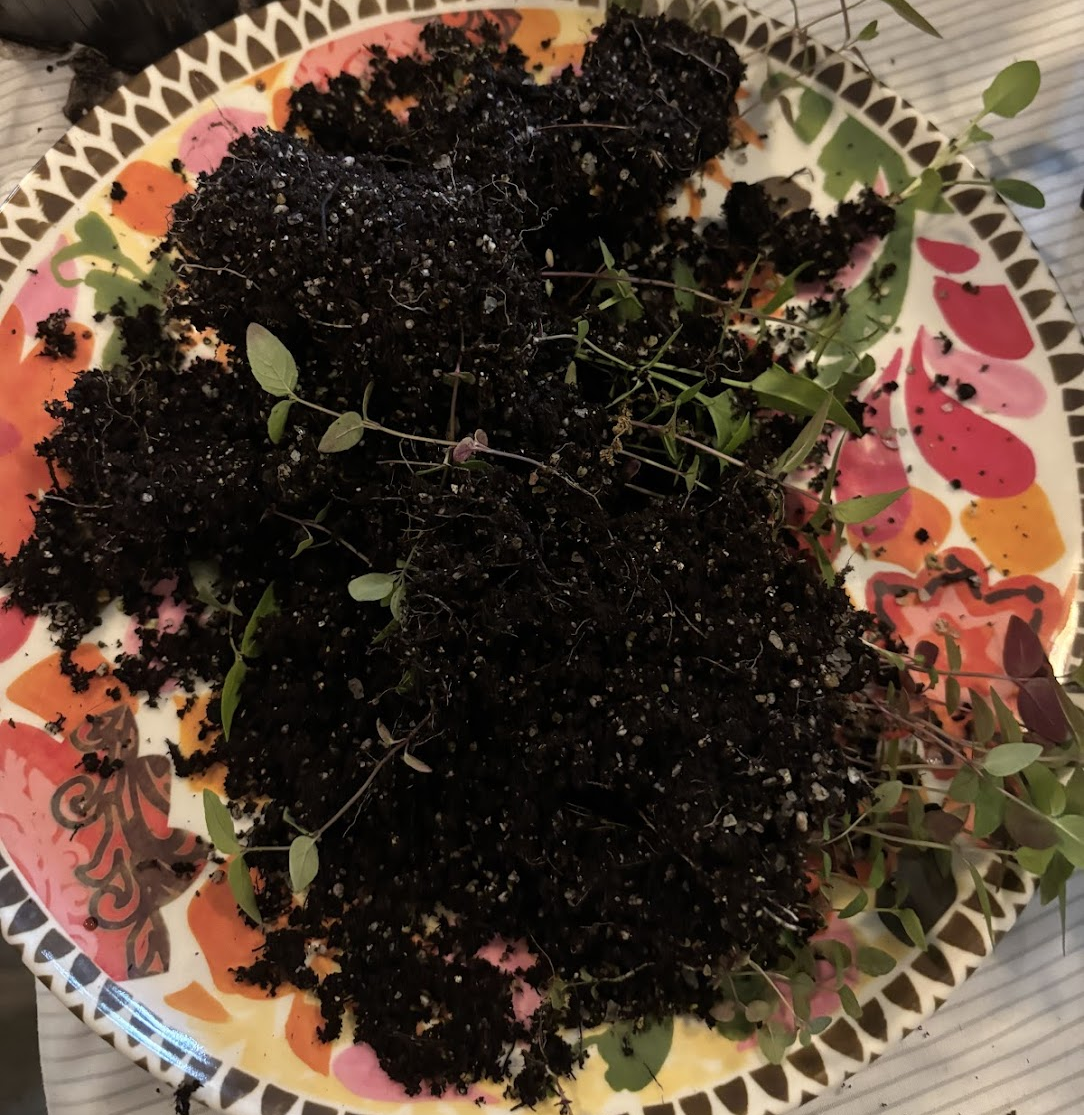
And while it's not difficult to separate the plants, it is incredibly time consuming. I've probably spent 50 hours total so far and still have eight more absolutely packed containers of plants to separate.
I initially thought it would be easier to separate the plants after they germinated rather than trying to put each individual seed into its own container, but I definitely think I'll do this the opposite way moving forward.
Placing a seed on top of some dirt is far less time-consuming than separating roots and dirt from dozens of sprouts and packing them into dirt in new containers. Plus, you can leave the seeds that didn't germinate in their containers to see if they eventually do anything.
I also learned that the containers I purchased were way too big. My first set of pots were four inches; they were great for the seed sprinkling method, but they take up way too much space and require far too much dirt for separated sprouts.
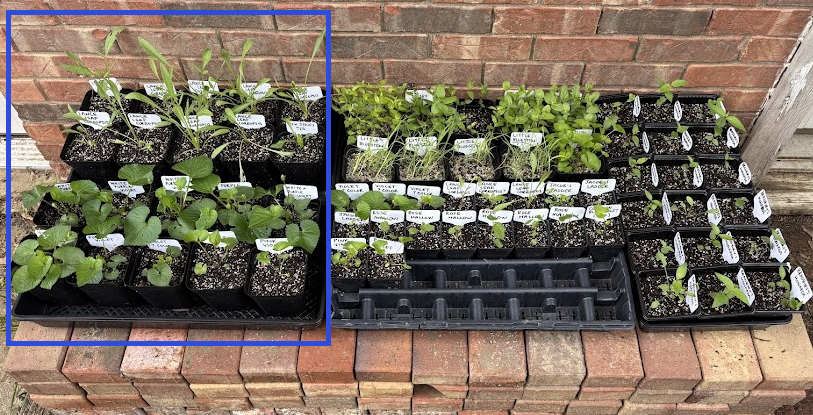
I then bought 3.5-inch pots hoping those would be better, but those were still bigger than what I needed.
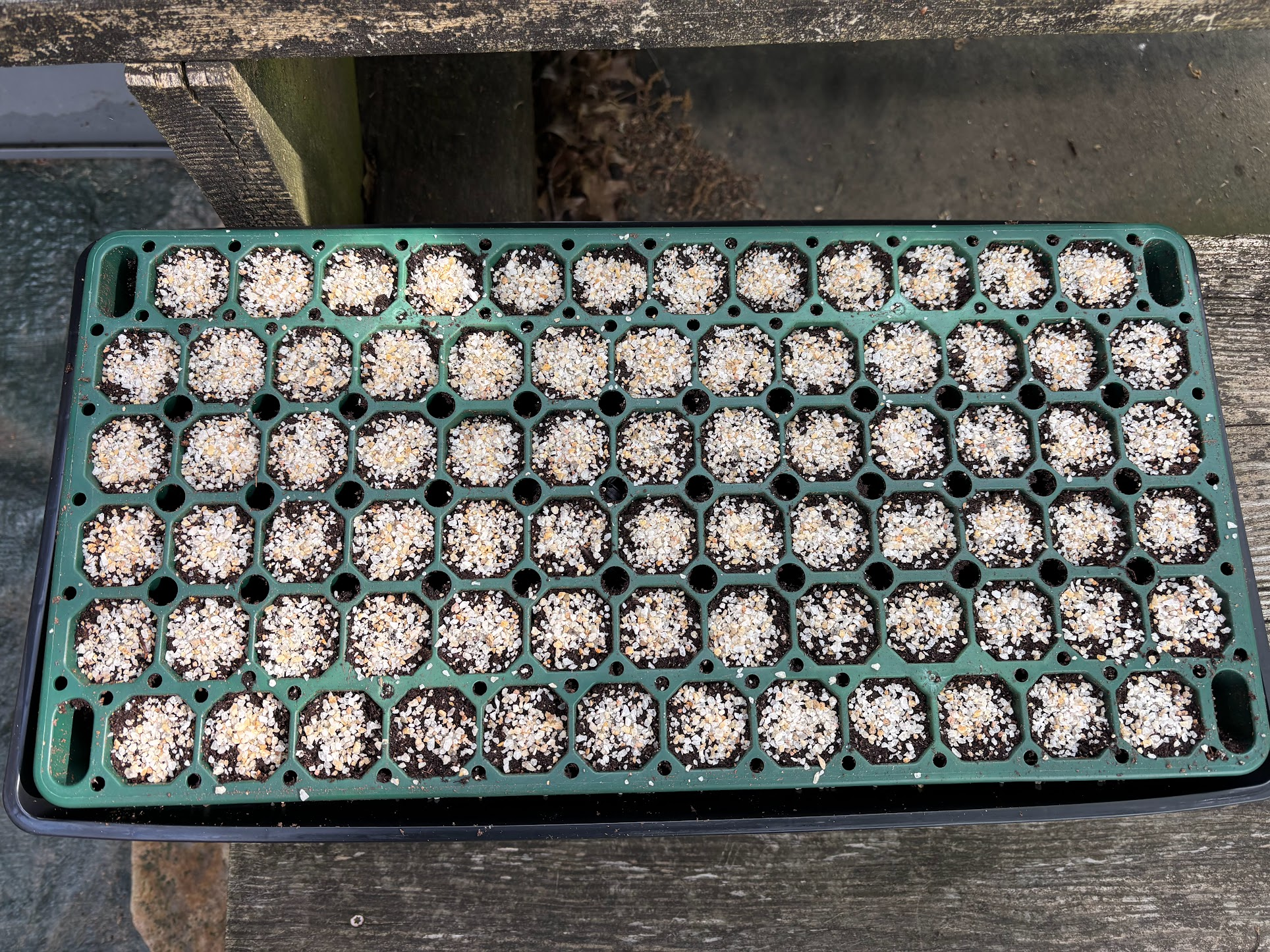
Next, I bought a few 76-cell trays (though those are for my refrigerator-stratified seeds — more on that in a bit), and while they're perfect for seed stratification, they're likely too small for transplanting sprouted seeds into.
The best containers were the ones that the plants I bought from Prairie Nursery came in. I'm guessing maybe they're two inches, but I haven't successfully found them yet; I just reused the containers that the plants I bought came in.
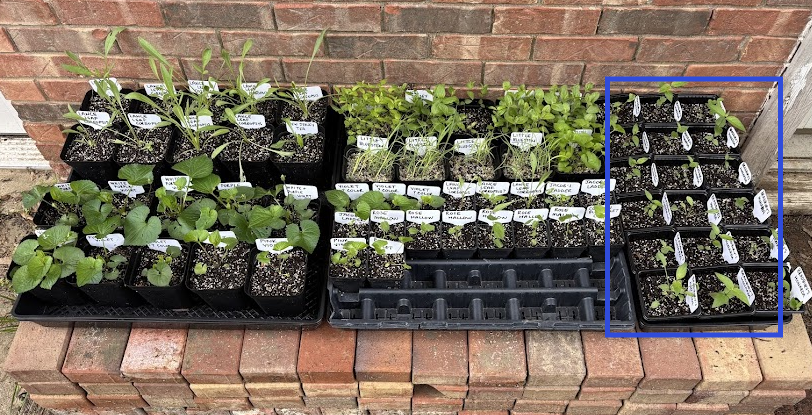
They fit 32 plants per 1020 tray. They have plenty of room for dirt for the plants to grow in, but they don't use up your dirt as quickly. Next year, I'm going to (find and) use that size container exclusively.
Refrigerator-stratified seeds
In addition to the seeds above that I germinated outside over the winter and am now working to separate and repot, I also had three bags of refrigerator-stratified seeds that were ready to be moved outside.
In bad news, it was another task on top of all of the planting I had to do and all of the repotting I'm still actively trying to finish this spring. In good news, it's an opportunity to try growing one seed per container and see how that goes.
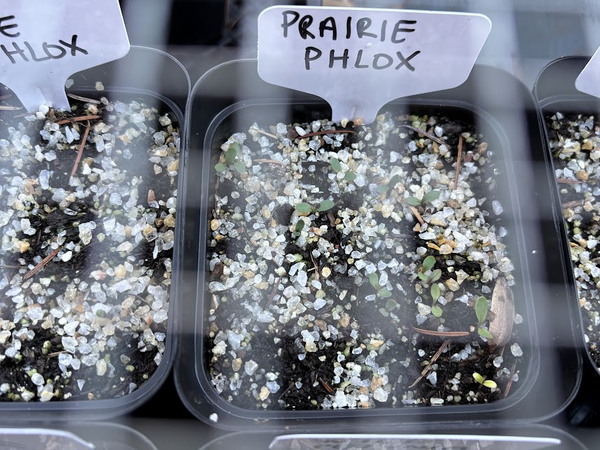
As I mentioned earlier, I found some really nice and durable 72-slot trays on Amazon and decided to use those. I started with my Wild Blue Phlox seeds. They were large and dark, which made them easy to see in the sand I used to keep them wet while they were in the refrigerator. I was able to grab a single seed and place it on top of the dirt easily.
When I was finished placing all of the seeds, I sprinkled some of my heavier sand on top to keep the seeds from washing away in the rain.
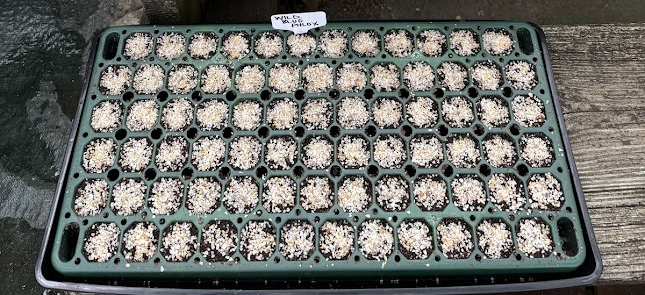
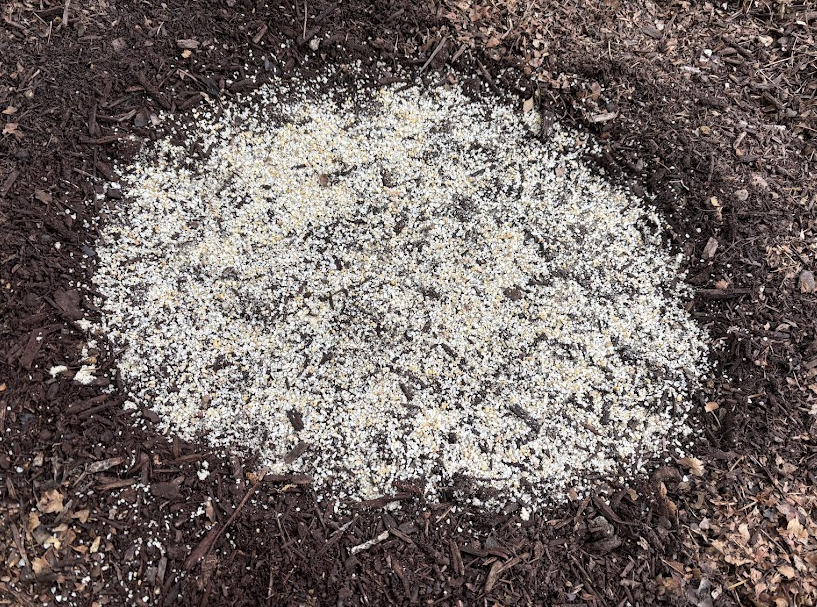
However, I ended up with more seeds than would fit in my tray, and I only wanted to use one tray per plant. So for the remaining seeds, I moved the mulch off of a circle of ground in my front yard garden, spread the remaining seeds and sand, and covered them lightly with heavier sand to keep them from washing away. Maybe they'll do nothing, but I do like to experiment.
The second seeds I worked on were Wild Strawberry (Fragaria Virginiana). These were a bit more complicated. Wild Strawberry seeds are minuscule, and they're not all that much of a darker brown than the sand I'd stratified them in. The result is that it was almost impossible to get a single seed into a single cell of my tray. I ended up just grabbing pinches of sand and spreading them on top of cells, hoping I was actually getting seeds in there — but not getting too many seeds in there.
My final seeds were Jacob's Ladder (Polemonium Reptans), which ended up being kind of in-between Wild Blue Phlox and Wild Strawberry in size. They were definitely harder to see than the Wild Blue Phlox Seeds but easier to see than the Wild Strawberry seeds, so I felt more confident that I'd gotten one seed of Jacob's Ladder into each cell than I did about Wild Strawberry — but not as confident as I was about the Wild Blue Phlox.
I also had more Jacob's Ladder seeds than I could fit in my tray, so I made a second circle in my front garden bed for the remainder of those.
I'll report back soon on how these do!
Lessons learned
I'm really feeling the effects of my sow-and-see approach to native gardening this spring. Stratifying and germinating seeds has been full of lessons-learned, but I feel like I will be in a much better place when I do this again next year. My biggest takeaways were:
- Simply sitting seeds on top of dirt, topping them with a light layer of heavy sand to keep them from washing away, and sitting them outside all winter is a super-effective method for stratifying and germinating seeds. I only had to water my seeds one time all winter, and I maybe didn't even need to do it then.
- Sprinkling a bunch of seeds on top of a single container saves time in the fall/winter but essentially defers the work to spring (and likely creates way more work overall). Going forward, I'm going to be a one-seed-per-container person.
- The jury's still out on whether or not stratifying seeds in sand in the refrigerator is effective, but what is clear is that seeds — particularly very small ones — are going to be much simpler to get into single cells of a tray if they're not mixed up in sand to begin with. I'm going to stick with the "put them on dirt and stick them outside for the winter" approach from now on, just with the adjustment that I'll put one seed in each cell rather than sprinkling them.
- Finally, I need to do some math to figure out if I actually did save some money by germinating these seeds myself. I think probably this year I didn't. However, if I keep doing this in future years and reusing what I've already bought, it probably will end up saving me some money. But if this is something you're only planning to do once to get some plants you need, it's worth comparing the total cost of all supplies — not just the cost of the seeds — to the cost of simply buying pre-grown plants.
In the end, though my first attempt at growing native plants from seed was wrought with lessons on things I could have done better, it was a completely worthwhile experience. I gained a ton of confidence through the process, feel like I will do a much better job next year, and could not be happier when I look out the window and see all of the plants I grew from seed growing taller and getting closer to being ready to be planted in the ground.
Next Post:
 Jessica Greene